Showing posts with label willowtip. Show all posts

Thursday, August 1, 2013

G&P Review: Infanticide

Infanticide
Misconception of Hope
Willowtip

I once had a Dodge Neon with a failing transmission. It would whine and strain and huff at low gear, but if you persevered and rode it out, it would eventually lurch into third and you were good to cruise. So that was all good, provided all you wanted to do is cruise around in third. That’s sort of how I feel about Misconception of Hope.
Sweden’s Infanticide have turned in a cruising record the revs past the low gears and never settles down again. But it feels like interstate cruising; it’s two lanes of blurring blacktop anonymity as songs slide into each other like endless highway mile markers. Infanticide are competent composers and performers, but Misconception of Hope is lacking some intangible vitality that would add some interest to this cross-country grindcore road trip. Instead, this feels like a monotone gray bit of background noise to fill the emptiness as you drive between the boundaries of two radio stations. The riffs never rise to the level of memorable and the overall production is missing that gut punch that blastbeat junkies crave. Even on the first listen you can anticipate where the growls will drop out and the shrieks take over. It all just feels so rote.
Infanticide’s prior work put them squarely in the 50th percentile of the grindcore Bell curve, but they were enjoyable efforts nonetheless. Ninety percent of Misconception of Hope evaporates like a gas spill in a hot parking lot the minute I stop listening. I’ll never forget that piece of shit Neon though.

[Full disclosure: Willowtip sent me a download.]

Friday, October 19, 2012

G&P Review: Noisear

Noisear
Turbulent Resurgence
Willowtip

The first and most important thing to know about Turbulent Resurgence: there is absolutely nothing even vaguely resembling “Noisearuption” to be found here. Sure, you have to sit through totally disposable intro/outro/intermission tracks, but they’re all a minute long and easily skippable. Other than that, Noisear don’t really deviate an iota from their wonted M.O.  Dorian Rainwater’s elastic riffs get twisted and mobiused around Bryan Fajardo’s Swiss watch-precision drumming. The Noisear formula is pretty familiar and settled at this point: Human Remains’ weirdest noises, slick Discordance Axis aggression, shards of Mortalized’s extra digit guitar wizardry, head-scratching Gorguts excursions and just a soupcon of James Plotkin’s most outré grind experiments get pureed and synthesized into a smooth shelled sonic suppository.
While the results are familiar, Turbulent Resurgence is still a bit of a mixed bag. Tipping the positive side of the ledger, the album is a lean 18 minutes, making it Noisear’s tightest, most compact offering in quite a bit. It’s a refreshing change from the overlong (not even counting “Noisearuption” on Subvert the Dominant Paradigm). However, Turbulent Resurgence is also lacking the latter’s dervish frenzy as well. The production is flatter and more to the point, as are most of the songs. That means there are fewer dizzying heights and murky lows to be found. Instead, Turbulent Resurgence finds Noisear grinding along at a (relatively speaking, this is Noisear, after all) even keel.
None of that is to say Turbulent Resurgence is a disappointment. For long time Noisear fiends, the latest record will excite all the appropriate cortical nodes. For newcomers, the leaner running time is the perfect entry into the band’s extradimensional aspirations. While casual grind fans will probably enjoy this one just fine, your serious blastbeat junky might walk away hoping for just a little bit more.

[Full disclosure: Willowtip sent me a download.]

Friday, July 20, 2012

G&P Review: Afgrund

Afgrund
The Age of Dumb
Willowtip

Let's just dispense with the most glaring issue off the top: that title. Yes, for their third album and their first primarily in English, The Age of Dumb is the best Afgrund could come up with, apparently. It's terrible; let's just acknowledge that and move on because, title aside, The Age of Dumb doesn't give you much reason to otherwise question these Swedes' judgment. Simply put this is yet another really good grind album.
The guitars this time are kissed with a touch more of that classic Swedish death sound, but otherwise it's the same propulsive grind you've come to expect from their first two outings. Afgrund hurtle bodily forward, never stopping to catch a breath and (mercifully) not indulging in the halfassed stoner doom excursions that gummed up the middle of Vid Helvetets Grindar. "Repaint the Truth," in particular, is a nice example of the Swedish grind arts, a wound up run through a minefield of blastbeats and razor wire screaming.
At this point in their career, Afgrund have very comfortably mastered their style and sound, and that may be one niggling complaint about The Age of Dumb. Afgrund have not advanced so much as refined their sound over three albums. What you hear with them is pretty much what you get. But I think they're capable of more. Afgrund have given us a series of really good albums, but I believe they are one of those bands with a truly great album lurking in them if they just push themselves. The refining is nearing its completion. The metal is pure. It's time for Afgrund to start forging lasting weapons.
In the mean time, The Age of Dumb will keep them firmly ensconced on many an end of year best of list. Even if that title is just plain dumb.

[Full disclosure: Willowtip sent me a download.]

Monday, April 16, 2012

G&P Review: Beyond Terror Beyond Grace

Beyond Terror Beyond Grace
Nadir
Willowtip
Beyond Terror Beyond Grace have moved far beyond simple grindcore with Nadir, a scalding wall of volcanic gases and suffocating clouds of gray ash.
The Australians once slotted neatly next to Maruta and Crowpath, but with Nadir they have abandoned any pretense at concision and driving blastbeats to experiment with girth, texture and tempo. Now they sound like Ulcerate songs reinterpreted by Circle of Dead Children with a rime of blackened frost. Eschewing the wonted grindcore brevity, the album is chock-a-bloc with nine minute death metal overtures that look beyond how many beats can be crammed into a minute. The ghost haunted lead off "Dusk" allots plenty of space for its atmospheric middle passage, which bifurcates the blastbeat opening and its screaming conclusion. The song imparts a sense of claustrophobia that coats the album like a greasy film.
That song lays out a template that a bulk of the album will follow. Nine minute bangers "Requiem for the Grey" and "Throatless Sirens" follow, riding the same churning swells and crests. Not that Nadir is a one trick gray-painted pony. The abbreviated title track is a concise instrumental that revels in melody bolstered by barely heard samples.
It's rather boggling to realize this the same band that gave us the pig-headed brawl of Extinction/Salvation just five short years ago. This doesn't sound like the same band at all (and it's not because the band slotted in a new singer and guitarist in 2010). Nadir may not be Beyond Terror Beyond Grace's zenith, but it shows a band waxing into their perihelion.

[Full disclosure: Willowtip provided me with a download.]

Tuesday, March 6, 2012

These Amazing Vibrations

I am a partially reformed collector.
I imagine many of you have grappled with your own level of craphound compulsion as well. As someone who has taken the step to reject readily available pop music, you're probably someone who invests your music with a deep significance given the extra effort you've taken to explore your musical options. (That's a gross and most definitely self-serving generalization, but just go with me here.) I'm betting the Venn diagram of underground music fans and obsessive collector nerds is practically 1:1.

Pictured: Obsessive collector nerd.

While I've moderated my buying the last couple of years (hence "partially reformed" collector), having my favorite albums at hand has always been important to me. But I've been thinking about the historic preservation of underground music lately after watching the documentary These Amazing Shadows. The movie discusses the work of the National Film Registry, which was created in the wake of Ted Turner's hare-brained scheme to bastardize classics with color, to preserve the United States' cinematic heritage.


Harmony Corruption

According to preservationists, half of the films made before 1950 have been permanently lost. Eighty percent of silent films are gone because nobody recognized their historic and cultural impact and sought to preserve them for future generations That really resonates with the amateur anthropologist in me. Those are pieces of our collective human heritage that are lost forever.
It has also gotten me seriously thinking about the future of underground music and wondering how (or if) key artifacts of our musical heritage will be preserved. While the internet has made virtually everything available with a quick trip to Mediafire, is anyone taking steps to preserve important musical landmarks? I worry the ubiquity breeds complacency. Did Siege realize what they had when they recorded Drop Dead and have those valuable master recordings been preserved? I bet 90 of the people who have heard S.O.B.'s seminal Don't Be Swindle (me included) have never seen a physical copy. Are compressed MP3s going to be the best we can hope for or are the original recordings stashed away somewhere waiting to be cleaned up and reissued?
Barring a radical cultural shift, we can't count on somebody like the Smithsonian or Rock 'n' Roll Hall of Fame swooping in to preserve our heritage for us. The history of punk and metal has been a tale of kids with a lot of ambition but not as much know-how figuring it out as they go along. I'm betting proper archiving was not high on their list of priorities.
The digital medium has proven more durable than its tape-bound antecedents, and label bosses said it's still their go-to storage device.
"I’m pretty sure [founder Jason Tipton] keeps all of the master recording in a drawer in his desk," Willowtip media guy Vinny Karpuszka told me. "Most of the time they are kept in the same CD case that was shipped to us from the studio that did the mixing/mastering. Some of the older ones are kept in one of those CD wallets that I’m sure everyone and their mother has owned at one point."
Unlike the majors, underground labels tend to have a more cooperative relationship with their bands. That often means it's the bands who are in charge of preserving their own music.
"Hydra Head does not possess any of the reels on which our earlier releases were recorded," co-owner Aaron Turner said. "Those (I'm assuming), are all in the possession of the bands themselves. We have a good number of DATs and CDr masters, but haven't archived them in any secure fashion. There's no real safety net protecting these things, except that most of them have already been released on CDs, which is relatively stable over the long haul. I hope artists of ours who did record on reels are keeping them safe! "
Just as the internet is decimating sales of physical media, it's also proving a boon to the preservation movement, providing several layers of redundancy, To Live a Lie honcho/IT guy Will Butler said.
"I do my part and upload out of print stuff; lately I've put some stuff on Bandcamp (and duplicated it to Archive.org, because I don't trust Bandcamp lasting forever)," he said. "I also have released some albums on iTunes/Amazon...etc, so although people are buying them, it's available and the songs almost become viral. Lastly, the actual masters, I have most of them on my hard drive on my computer. I then duplicate them to my home server which has all RAIDed harddrives, so it's basically triplicated on my home network. So a multi-tier approach to keeping music alive. I mean one day I'll be forty and might not be involved in the label and will hope that I did something positive for the world, so making the music an awesome music virus around the world, living on computers and being shared on P2P networks, and keeping copies for myself is actually an interesting/worthwhile idea!"

Return to Desolation

Extreme metal is entering its third decade of existence, but institutionally, it's still in its infancy. The scrappy labels that have enshrined themselves in our experience -- Metal Blade, Earache, Relapse -- are still defined by their founders and much of our heritage is locked up in their vaults. Time will only tell how they evolve giving the changing musical landscape and their founders' plans to maybe one day call it quits.
Butler is already making plans for the day when he may fold up shop.
"I'll probably make an effort in a few years, if I stop the label, to post everything up free online with the band's permission. Seems silly to not have them on Archive.org for preservation," he said.
One aspect of punk and metal that has always struck me is the reverence for our shared heritage. There are not many fans of mainstream music reaching back 30 years to appreciate the musical canon that gave birth to their current favorites the way we do. I hope we find a way to preserve our little musical subculture. Think about how many obscurities and lost gems that have already fallen out of print and may essentially be lost. With a little luck, when I finally go deaf I'll turn over control of the Childers Memorial Grindcore Repository and Punkatorium to another generation who will appreciate its significance as a subcultural milestone much the way I do.
"I think there's enough nerds out there (myself included), protecting their collections that most of these great records will live on in some form or another," Turner said.

Wednesday, August 17, 2011

G&P Review: Maruta

And thus, through the serene tranquilities of the tropical sea, among waves whose hand-clappings were suspended by exceeding rapture, Moby Dick moved on, still withholding from sight the full terrors of his submerged truck, entirely hiding the wrenched hideousness of his jaw. But soon the fore part of him slowly rose from the water; for an instant his whole marbleized body formed a high arch, like Virginia’s Natural Bridge, and warningly waving his bannered flukes in the air, the grand god revealed himself, sounded, and went out of sight. Hoveringly halting, and dipping on the wing, the white sea-fowls longingly lingered over the agitated pool that he left.

Herman Melville
Moby-Dick or, The Whale

1851


Maruta
Forward Into Regression

Willowtip
Forward Into Regression has been my white whale for the better part of the year. The travails of my futile hunt for Maruta’s latest effort are probably only of interest to myself, but I have stalked the land like Ahab in his mad quest for Moby Dick until Mitchell Luna kindly relieved my suffering.
The Floridian’s sophomore power violence-mauling-grind in a drunken party brawl effort is a stronger, more confident distillation of everything that made In Narcosis awesome. There’s a definite upward swing to their growth. The signature slouching guitars have a 3D depth and the new rhythm section (complete with bass!) doesn’t alter their wonted sound. Instead, much like GridLink’s lineup shuffle pre-Orphan, it gives the band a larger platform from which to stage their assault. In Narcosis has been run through a rigorous bootcamp the last few years and Forward Into Regression has come out more toned and muscular as a result.
Both “Stagnation Routine” and “Salient” boast are a more focused deployment of Maruta’s penchant for slow parts without stalling the album’s momentum. The knuckle draggers now feel purposeful and pointed, like a knife twisted in your ribs to prolong the pain. If there’s only one misstep on Forward Into Regression, it’s that “Failure King” rides a single musical notion too hard for an interminable three minutes. However, that’s easily overlooked considering the closing body blows of “Gaiares” and “Blood of the Luddite” quickly right the ship.
Once I landed this white whale I immediately trucked it over to the local taxidermist so it could be stuffed and mounted on the mantle among my other trophies. As of today my 2011 top 10 list has a mathematically improbable 13 albums on it. Somebody’s about to get bumped to make room for Maruta.

[Full disclosure: The band provided me with a review copy.]

Wednesday, July 13, 2011

Steelers: Willowtip and the Pittsburgh Four (+1)

LinkThere was something brewing in Pittsburgh in the late 1990s and into the start of this century, and it wasn’t the city’s fondness for pisswater beer. There was a surly, bruising breed of death/grind monstrosities that packed all of the wallop of the burnt out industrial burg’s vaunted Steel Curtain defensive line. I went to college a couple hours outside of the city at the time and much of my metallic worldview was formed during shows at the dearly departed Club Laga. I can’t remember ever seeing any of these bands there, but by the late ’90s their names were already circulating through the pits.
Pittsburgh deathgrind, centered on the up and coming Willowtip label, was an incestuous tumult of bands and musicians who set out to make ugly, forward thinking music that compares favorably to the Phoenix scene of the same era. The insularity and spirit of collaboration that dominated at the time ensured the best ideas had been put through a proving process that fired away the dross, leaving only a core that was as grim and hardened as the steel mill shift workers.
The bands, following the trail of forerunners such as Human Remains and hometown heroes Hideous Mangleus, were not slaves to the traditional death metal ruts so many other bands churned at the time. This was music that was often ahead of its time, and you can draw a direct line to subsequent artists such as Luddite Clone, Noisear and Maruta. In the process these are also the bands that help establish one of the finest labels supporting great music today.

Circle of Dead Children
The Genocide Machine

Willowtip
2001

Circle of Dead Children were and are Pittsburgh’s nexus. They’re the last man standing and best exemplars of the city’s deathgrind ugliness and 2003’s The Genocide Machine was their apotheosis. This is a grim, grisly feral album that doesn’t wallow in so much as celebrate humanity’s impending, self-inflicted doom. It's all the more surprising considering the meh-diocrity of their prior full length, Starving the Vultures. The coal-blackened guitars churn up the kind of slag-laden sludge you can only find along the coal barges docked along the Allegheny and Monongahela rivers. The drums are the pounding of a steel foundry cranking out the girders that built a nation while Joe Harvarth is the living voice of the clock-punching shift worker who stopped short of going full Travis Bickle on his neighbors' asses for another day.
Circle of Dead Children are the apex predator of Pittsburgh’s musical underbelly because they have proven infinitely adaptable. As contemporary bands dissolved, members were systematically absorbed into CODC in a process of constant musical transfusion that has kept them hunting and vital.

Link
Creation is Crucifixion
Automata

Willowtip
1999

A full decade before either Anonymous or Lulz Sec decided to shred residual notions of online security in the name of drollery or trollery or some ideological point they have yet to articulate, Creation is Crucifixion were passionate proponents of the hacktivist lifestyle. Their music was just as visionary and may only be finding its moment today. First full length Automata found the band blending stolen samples, audio experiments and their own roiling cyborg ant colony riffing with a lyrical obsession with subverting the consumerist impulse and bending technology to their own techno-anarchic ends. CiC were grappling with the intersection of humanity and the digital culture long before it became fashionable. The music was just as visionary. Churning maelstrom blastbeasts backline suffocating waves of silicon-sharp guitars that squeal and skronk like protesting machinery. Whey Skynet goes sentient, Creation is Crucifixion will be the fitting soundtrack as the bombs start dropping. Like the band boasted, this is where technology and anarchy fuck.

Fate of Icarus
Cut Your Throat Before They Do

Willowtip
2000

From humble beginnings as a rather straightforward death metal band with grindcore inflections, the short lived Fate of Icarus developed a unique, slurring riff style for the underrated Cut Your Throat Before They Do. Fate of Icarus stood as the pivot between Circle of Dead Children, whose throat monster Joe Hovarth chipped in mic work on some early tracks (collected on Suffocate the Angels), and the parallel dimensions being inhabited by Creation is Crucifixion, with which the band shared guitarists Ryan Unks and Adam MacGregor. (Bonus points: The band also boasted links to Pittsburgh crossover goofs Crucial Unit as well.) Fate of Icarus’ protein-laden death was interwoven with roiling maggots of guitar histrionics that gave the Cut Your Throat its prickly texture. Songs roar along at just sub-blastbeat tempos, placing the burden on the other instruments to carry the musical load. This is pissed off swarm of hornets (dressed in the black and yellow, natch) with iron wings and a truly bad attitude.

Sadis Euphoria
Instinct/Obsession

Willowtip
2003

While Sadis Euphoria’s lumbering, traditional death metal lurk may have positioned them as the Lenny to their contemporaries’ more ambitious George, their gurgled take on Cannibal Corpse by way of some grind influences slouched and snarled with the best of them. Sadis Euphoria were Pittsburgh’s anchor to traditional death metal with a focus on slab-sided riffs and shotgunned drumming. Everything is propulsive and concussive, dropping like a dirty bomb at the city core with timely farting bass breakdowns and vocals churned up straight from the duodenum. Though Sadis Euphoria never seemed to find their foothold among the death metal hordes, drummer Mike Bartek and one-time Sadis bassist Drew Haritan both suited up for CODC’s Zero Comfort Margin, carrying their band’s musical tradition forward.


Bonus Beating From Across the Border:

Rune
The End of Nothing

Willowtip
2003

Dayton, Ohio’s Rune were birthed 255 miles too far to the west to truly count as a Pittsburgh band, but if we’re charting the rise of Willotip’s early core, they have to be included. After an early EP of traditional deathgrind murder and a split with New York’s Kalibas, Rune migrated to Willowtip for their farewell mindfuck The End of Nothing. This is a protean band that showed a different face with ever release. Here, their doomed out death is what Neurosis songs would sound like as played by Morbid Angel. Everything is groaning and miserable, flecked with emotive, evocative riffs and swirl like poorly vented smokestack choking the neighborhood with toxic emissions. The End of Nothing sounded like absolutely nothing anybody was doing at the time – or today for that matter. It’s doom death that keeps the focus squarely on the death part, knowing when to drop in a timely blast to keep things from wallowing too deep in the mire. Sadly, the band evaporated like mist in a dreary forest shortly after the album was released. Members moved on to bands like Kenoma and Mouth of the Architect, but they never recaptured the thunder the way they did on The End of Nothing.

Monday, April 4, 2011

G&P Review: Macabre

Macabre
Grim Scary Tales

Willowtip
Anyone who has ever sat down with an unexpurgated copy of Grimms’ Fairy Tales knows the Helen Lovejoys of the world constantly screeching about children being exposed to sex or violence are full of shit. Violence is an intrinsic part of the human experience and there was a time when children were not shielded from those (*ahem*) grim realities.
Having sung the praises of pretty much every twisted, murderous maniac of the 20th Century, Chicago “murder metal” (their term for bits and pieces of thrash, grind and death) purveyors Macabre go digging through their history books on fifth full length Grim Scary Tales.
While Macabre have long drawn plaudits for a 20 year streak of consistently enjoyable if not necessarily essential serial killer grooves on albums like Dahmer and Sinister Slaughter, Grim Scary Tales shows the band crafting some of its most clever tunes to date, exploiting a globe’s worth of musical styles to make their rhetorical points from the itsa-me-Mario pizza hall bounce of “Nero’s Inferno” to the plaintive faux ballad strains of “Mary Ann” or the jarring juxtaposition of the nursery rhyme cadence of “The Big Bad Wolf” with its sinister lyrics. Along the way we’re treated to songs about a host of bloodthirsty historical personages such as Gilles de Rais (of “Enter Crypts of Rays” fame), Burke and Hare and a by the numbers cover of Venom’s “Countess Bathory” to complete their pokemon collection of historic maniacs.
Grim Scary Tales is another decent but not mindblowing collection of murderous mayhem from an often unheralded band of bloody minstrels. If you’ve never indulged before, this is just as good a place as any to get acquainted with their sanguinary distillation.

[Full disclosure: Willowtip sent me a review copy.]

Wednesday, March 30, 2011

G&P Review: Ulcerate

Ulcerate
The Destroyers of All

Willowtip
Of all the tricks in a film director’s repertoire, the one I probably find most engrossing is the long tracking shot. The long take is so dramatically compelling and the long, unbroken takes force actors to really perform off each other in a way that’s more organic than Hollywood’s insistence on two second scenes. When you mention great long takes, most people will point to Scorcese’s famous Copa Cabana scene in Goodfellas. That’s certainly a great scene, but don’t forget the amazing long takes in Children of Men (yes, digital trickery was involved), the phenomenal trench scenes in Kubrick’s Paths of Glory or drunken pub patrons enacting their own solar system in Bela Tarr’s apocalyptic Werckmeister Harmonies. But the king of all tracking shots is Aleksandr Sokurov’s Russian Ark: a whole 90 minute movie that’s one unbroken tracking shot that wends through St. Petersberg’s Winter Palace, featuring a cast of nearly 1,000 -- including two full live orchestras.
I get that same sense of dramatic profundity and technical mastery from Ulcerate’s latest album The Destroyers of All. It’s not enough that the songs have emotional content, but those emotions should move and expand over the course of a song. Hell, you could consider the entirety of the album to be single sinuous thread that streams you along for the better part of an hour. The swaying, viperous grace of “Omens” snaps against a blastbeaten back line while the ominous magma flow riffs of “Burning Skies” wash over the hurried double bass pounding of the drums, incinerating everything in its path and then just abruptly stopping, leaving the song hanging without resolution. But “Dead Oceans” immediately seizes that lingering anxiety, twisting the need for an emotional payoff into a warped, flayed bit of guitar strangulation.
The Destroyers of All’s slow motion apocalypse of fire is irresistibly compelling, building off what made Everything is Fire such an enjoyable listen and immolates it as a burnt sacrifice to your pleasure.

[Full disclosure: Willowtip sent me a review copy.]

Monday, July 5, 2010

G&P Review: Defeated Sanity

Defeated Sanity
Chapters of Repugnance

Willowtip

Then suddenly I saw it. With only a slight churning to mark its rise to the surface, the thing slid into view above the dark waters. Vast, Polyphemus-like, and loathsome, it darted like a stupendous monster of nightmares to the monolith, about which it flung its gigantic scaly arms, the while it bowed its hideous head and gave vent to certain measured sounds. I think I went mad then.
H.P. Lovecraft
“Dagon”
1917

Chapters of Repugnance certainly left me at the frayed ends of my sanity, but probably not for the reasons these German death dealers intended. Rather, because ohyourfuckinggod is their third album and Willowtip debut tedious. I tried to groove to Defeated Sanity’s skittering, busy technical breed of death metal but the unrelieved tempos and clanking machinery songwriting become grating, even for an album that’s only half an hour long.
From first note to last, Defeated Sanity, who clearly know their way around their instruments, hulk along at an almost unchanging midtempo driven by maddening teletype double bass and the bowel loosening grunts of a man waking from an all night Taco Bell binge. “Engulfed in Excruciation” sums up the experience pretty well because repeated listens to Chapters of Repugnance’s Dying Fetus-style tedium became a chore I absolutely dreaded.
But there were bright spots, fleeting as they were. “Salacious Infinity” casts a meager life saver for being moderately faster than the rest of the album. “Blissfully Exsanguinated” hints at what Chapters of Repugnance could have been as it cowboys a crushing bass groove that makes the whole song just feel larger and more menacing than the remaining death metal paint by numbers rehash.

Defeated Sanity – “Blissfully Exsanguinated”

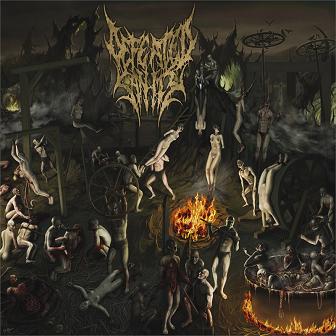
Had the rest of the album been that brutish and ugly, Defeated Sanity might well have delivered an album worthy of the Bosch-esque grotesquery of the cover. Instead, I’m left to corral the shattered shards of my once (relatively) stable psyche after subjecting it to repeated lashes from this wholly unnecessary exercise. The Old Ones have never been more merciless.

[Full disclosure: Willowtip sent me a review copy.]

Thursday, July 1, 2010

G&P Review: Fleshgod Apocalypse

Fleshgod Apocalypse
Mafia
Willowtip
Classically-attuned Italian death metallers Fleshgod Apocalypse seem to be pulling an anti-Coppolla with their releases. If you’ll indulge the strained simile, the band pooped out their Godfather III last year with debut album Oracles, which never managed to fully integrate their neo-classical compositions into the mix, leaving their death metal to override their overtures in a way that served neither. But, having failed that miserably in service of a noble idea, Fleshgod Apocalypse had nowhere to go but up, and fuck me if five-song EP Mafia isn’t an absolute stunner.
Now rather than tacking some string arrangement or bit of piano frippery on to the end of the song, Fleshgod Apocalypse have folded the two together seamlessly, forging an alloy with the tensile strength of death metal and the suppleness of their Baroque forebears. For only 20 minutes, Mafia is absolutely operatic in scope, befitting its mob-inspired themes.
“Thru Our Scars” and “Conspiracy of Silence” are both protein-laden hunks of death metal that give way to intricately knitted strings of notes ripped and jolted from a harpsichord. The gut busting grunts are also augmented with the introduction of a Messiah Marcolin-to-King Diamond wail that brings just one more finely honed layer to the proceedings (and I’m someone who can’t normally stand King Diamond).

Fleshgod Apocalypse – “Thru Our Scars”

A faithful but no less devastating version of At the Gates’ “Blinded by Fear’s” majestic melodic flourishes also perfectly complements the sweeping vistas of Fleshgod’s vision. Bringing the mob-theme home at the end, the band closes with the piano instrumental title track which sounds like something Tessio would be pounding out on an out of tune piano as the Corleone men hit the mattresses for a prolonged gang war.
Fleshgod Apocalypse are smart, Michael. They’re not dumb like I previously said.

[Full disclosure: Willowtip sent me a review copy.]

Monday, June 28, 2010

G&P Review: Circle of Dead Children

Circle of Dead Children
Psalm of the Grand Destroyer

Willowtip

An open letter to Scott Hull:

Dear Mr. Hull,
We’ve never spoken, but I just had to take a brief moment to thank you for not being Steve Austin.
To the best of my knowledge, sir, you have neither stolen a drummer from Circle of Dead Children to further your own musical aims nor have you hellaciously fucked up the band’s sound on an album from the producer’s chair, rendering it flat, stale, lifeless and a groaning diarrheal disappointment (see also, Comfort Margin, Zero). No, Mr. Hull, I just wanted to thank you for the thunderfucking crack of doom bass that dredges through Psalm of the Grand Destroyer opener “Avatar of Innocence.” While the Pittsburgh band’s last couple of albums have been serviceable, even fleetingly enjoyable amalgams of death metal brute and grindcore windshear, Psalm of the Grand Destroyer played to Circle of Dead Children’s strengths as the last men standing of the Steeltown scene, an incestuous merry go round of characters who would man CoDC, Fate of Icarus, Creation is Crucifixion and Sadis Euphoria in the name of brutal fucking noise. And given frontman Joe Hovarth’s mano a mano bout with a near fatal staph infection, just seeing a new album from the band is reward enough for now, Mr. Hull.
Though the band proudly proclaims they “Refuse to Kill the Same Way Twice,” Psalm will be comfortably familiar to anyone who flipped their shit over The Genocide Machine. Revisiting “Ursa Major” from debut album Starving the Vultures, likewise, adds nothing new, but that’s kind of the point, isn’t it, sir? Mr. Hull, you’ve cleverly just let the band do what they do best with minimal interference as they ravage songs like “Obsidian Flakes,” letting the tinkling, almost subliminal introduction build until a photonegative storm front rains a black-flaked blizzard of ravaged death metal over a grim, lightless underworld.

Circle of Dead Children – “Obsidian Flakes”

No, Mr. Hull, you’ve simply primed the canvas for Circle of Dead Children, whether it’s deft touches like the funeral march lament of the grave weary “Germinate the Reaper” or allowing Hovarth’s multiple personality vocals – a veritable galaxy of death rattle gargles, bone gnawing rasps and hellacious underworld groans – to take their rightful place in front of “Last Words and Warning Signs.”
So, in closing, Mr. Hull, again I wish to thank you for not being Steve Austin.

Yr obt. and faithful svt.,
Etc. etc. etc.

[Full disclosure: Willowtip sent me a review copy.]

Tuesday, April 20, 2010

G&P Review: Defeatist

Defeatist
Sixth Extinction

Willowtip
With an album title that references paleontologists Sepkoski and Raup’s five major extinction events, New York’s Defeatist seem intent on hurrying along the evolutionary process with their proper full length debut, Sixth Extinction. It’s an album of grindcore blistering and noise rock corner sniping that relentlessly pummels its victim, probing for any chink in your survival skills. The piano wire garrote of “Heresy Delusion” fluidly transitions into the soft tissue trauma of “Fall in Line” like a Tyrannosaurus Rex-themed kata. The chumming thrum of “Death Holds Her Brood” sees its doomed thread spooled back in two songs later on “Ways of Weakness” and the spontaneous, shapeless noise whiteout of “Man’s Inhumanity to Man” will be immediately, comfortingly familiar to anyone who ever worshipped at the altar of Anodyne, where Defeatist’s rhythm section previously coalesced. Joel Stalling has turned in so many tooth chippingly awesome drum performances to date I almost forget just how much of a world eating badass he really is, particularly lock in with long time bass consort Joshua Scott and ex-Kalibas guitarist Aaron Nichols.
The twisty, askew stumble of “Without Will” is a wrenched amalgam of noise rock angularity and grindcore acceleration that succinctly encapsulates the Defeatist milieu, ram-rodding square peg elements of their prior efforts into grindcore’s humble round hole.

Defeatist – “Without Will”

I have only two complaints and they’re relatively mild. First, the production on Sixth Extinction is feels the slightest bit duller than some of the tracks on Sharp Blade Sinks Deep into Dull Minds. While it’s particularly noticeable when you listen to them back to back, it’s far from a deal breaker. The second is one I’ve raised before: I keep waiting for Nichols to widen his vocal vista. Far too many of the songs feel trapped in a Rarr, rarr, rarr, rarr; Rarr, rarr, rarr, rarr trap that saps the dynamism of the music itself. But that’s so hard to focus on when a hungry horde of musical velociraptors are questioning your very fitness to survive.

[Full disclosure: Willotip provided me with a review copy.]

Friday, April 16, 2010

G&P Review: Infanticide

Infanticide
From Our Cold, Dead Hands
Willowtip
Sweden’s Infanticide make me want to run through the ObGyn unit of my local hospital with a razor honed Wustof gutting pregnant chicks. Or maybe just ordering a really nice veal parmesan. Either way some fetal blob of barely developed mammal protein will have a bad day with From Our Cold, Dead Hands providing the perfect soundtrack. As your grindcore sommelier, I’d recommend pairing Infanticide with a nice selection from Deathbound because like those ferocious Finns, the Swedes crust their grindcore with a seasoned panko rind of guttural death metal heft, more strategically deploying the blastbeats than their contemporaries.
You take those death metal elements to the grill almost immediately as “Domestic Warfare” scales back the throttle for 75 seconds of Swede death loom before the two beat eruptions place things squarely back in the realm of grind. It’s those kinds of moments – like the way The Fourth Crusade gets a 21st Century panzer sheen on the stunning “Shock and Awe” – that provide tension and dynamism against From Our Cold, Dead Hands’ suitably clanking production.

Infanticide – “Shock and Awe”

But fear not, for all the downbeat chug, those are just the crusted protrusions in Infanticide’s grind freakery. “Militant Resentment” brings all the charm of a rusted dental drill cracking open an abscessed tooth, “A Worse Today” brings the punk banging by way of Entombed and “Crisis Point” is pure cluster bomb annihilation. There's not a damn thing here that hasn't been a few dozen times before, but for what it's worth, Infanticide hit all the comfortable pressure points. You can pry this one … wait for it … from my cold, dead hands.
[Ed’s note: I’m so very, very sorry.]

[Full disclosure: Willotip provided me with a review copy.]

Tuesday, December 15, 2009

G&P Review: Squash Bowels

Squash Bowels
Grind Virus

Willowtip
Lucky man that I am, I recently did battle with H1N1, and "Squash Bowels" pretty much sums up how I felt for that week. Not because of the flu, which consisted of a cough, savage fever and a week shambling around the house in a bathrobe like an Ozzy impersonator. No, the intestinal torture was a byproduct of the Tamiflu I was prescribed. What nobody told me was the side effects of Tamiflu include gut wrenching stomach cramps and the kind of projectile vomiting that would do Linda Blair proud.
I would love to have been there for that drug pitch meeting. "Well, we have this amazing flu remedy, but the side effects are worse than having the flu."
Grind Virus, Squash Bowels’ first full length solo effort since 2005’s Love Songs, is a particularly infectious strain because the Polish trio (featuring Arthur, the bass player from Exit Wounds) isn’t determined to break land speed records. Squash Bowels realize it don’t mean a thing if it ain’t got that swing. So they ease off the accelerate enough to bring the old school crush of Repulsion worshipers Cretin (portions of “Shit Oneself” sound enough like “Cock Fight” a paternity test may be in order) blended with the body horror fixation of Sewn Shut (with whom they’ve shared a split). The loose, relaxed approach gives “Don’t Look a Gift Horse in the Ass” – a seminar in grindcore songwriting economy – an almost thrashy tinge and spotlights the brain drill attack of “Two Cows and Monkey.” When Squash Bowels do cute loose with the speed, drummer Marius’ crashing, strident style gives the blasting a sense of impact.
In an era of overblown swine flu panic, Squash Bowels are a very effective curative. Side effects may include nausea, vomiting and a profound sense of satisfaction.

Tuesday, October 13, 2009

G&P Review: Gorod

Gorod
Process of a New Decline

Willowtip
According to French metallions Gorod’s cosmology, an advanced extra-terrestrial species known as the Chaosmongers the Minarians come to Earth with the intention of bursting through Dimension Hatross enslaving and exploiting humanity after first guiding them through an evolutionary “autodestruction phase.” Somewhere in all that an alien ambassador named Soracle, the shadowy Obsequim Minaris society and some guy named Adam play prominent parts. Are you lost? Yeah, me too. I’ll just assume in the end we find out it’s a cookbook!!1! (Fun random fact, Richard Kiel of James Bond Jaws fame played one of the aliens in that episode.)
Mockery aside, Gorod’s third album of sci fi encrusted technical metal shenanigans hits all the right calculus-core equations required of the genre. The songs skitter like a chunk of butter dropped into a ripping hot skillet, refusing to settle on any single riff or movement for long but rather slide and splatter around you. A song like “Programmers of Decline” hops about between fragments of riffs like nanoscale robot fleas.
Gorod are at their best when they blithely skip away from tech metal convention. Opener “Disavow Your God” busts out a transcendent melody right before the two minute mark that glances off the song’ more protein packed sections is easily Process of a New Decline’s highlight. After your obligatory Martian invader of the Theremin-style opening, “The Path” veers into almost gothic and *gasp* poppy bridge that bounces cleaner vocals off of FXed ad astra guitars in a pairing that harkens back to Dark Tranquility circa Haven. Ditto with “Watershed,” which warps into delicate alien arias that highlight not only Gorod’s obvious technical mastery but the always elusive songwriting craft as well. That may be Gorod’s strongest point. Tech metal is custom crafted for self indulgence but Process of a New Decline shows Gorod know how to ruthlessly edit out the frippery when a song like the relatively straightforward “Splinters of Life.”
Tech metal isn’t my thing but I can appreciate the craft and artistry that went into Process of a New Decline. While it will definitely set the graphing calculator set aflame with passion, I just don’t see it converting outsiders like me.

[Full disclosure: Willowtip provided me with a review copy.]

Tuesday, July 14, 2009

G&P Review: Magrudergrind

Magrudergrind
Magrudergrind
Willowtip
It’s hard to picture Norwegian black metal evolving as it did were it not for its fog-wrapped forests and ice-floe choked fjords as a backdrop. And we never would have been blissfully pummeled by the nihilistic machinery of Godflesh if the industrial clang and smog-choked atmosphere of Birmingham hadn’t weighed upon Justin Broadrick so oppressively.
My point being, grindcore tends to lack a sense of place. It’s either involved with issues too macro (war, destruction, government malfeasance) or too micro (just how many severed cocks can you cram in a suppurating pussy?) to take notice of its surroundings and draw inspiration from its own neighborhood.
None of that would have occurred to me were it not for Magrudergrind whose eponymous second album and Willowtip debut so perfectly encapsulates D.C. – a schizophrenic city that’s both overwhelmingly poor and black and at the same time home to the nation’s white (in every sense of the word) halls of power. But the trio of Avi Kulawy (vox), R.J. Ober (guitars) and Chris Moore (drums) thoroughly capture the city’s vibe on a sample-laced album that touches on themes of gentrification (“Fools of Contradiction”) and the divide between D.C.’s Fedland core and its impoverished southeastern swath (“The Price of Living by Delinquent Ideals”). Even the elegiac and stirring “Martyrs of the Shoah,” the last true song on the album, comes off as downright prophetic after a geriatric bigot from the burbs decided to shoot up the Holocaust Museum to impress the RaHoWa retards back home.
Sonically, everything is polished to a sheen courtesy of producer Kurt Ballou and mastering by Scott Hull (who selected the band for his This Comp Kills Fascists throwback) as Magrudergrind blast through half an hour of ferocious punk at the nexus of grind and power violence. The Magruders do throw the occasional curve ball with the slow kindling “Bridge Burner” or the hometown shout out, white boy funk of “Heavier Bombing” that’s one Chuck Brown cameo short of perfection.
This is the sound of band coming into their own, kicking back with a half smoke at Ben’s Chili Bowl and deciding to pen a love note to the city.

[Full disclosure: Willowtip graciously provided me with a review copy.]

Wednesday, June 17, 2009

G&P Review: Defeatist

Defeatist
Sharp Blade Sinks Deep into Dull Minds
Willowtip
Joel Stallings is a fucking beast who can rock a drum kit along side grind luminaries like Dave Witte and Bryan Fajardo. Despite my ongoing, undying, everlasting man-crush on Mike Hill, Stallings’ concussive yet textured playing was the secret sauce that powered the last pair of Anodyne albums. And just in case you need a refresher course, Defeatist’s “Snuffed” and “Loathe” give Stallings a palette to get all Jackson Pollack in bruised shades of black and purple.
After waxing ecstatic for the first few years of their existence, Defeatist has tag teamed with Willowtip to collect all of their vinyl splits and 7-inch solo shots onto one handy plastic platter with Sharp Blade Sinks Deep into Dull Minds. From the black and white street grit artwork through the deliberately low-fi battery, New Yorkers Stallings, ex-Anodyne collaborator Joshua Scott and ex-Kalibas guitarist Aaron Nichols conjure the glossed over scuzz of the city before Guiliani decided to turn Times Square into Disney Land.
Nichols’ high pitched vocals can be a bit monotone and repetitive over the course of a full length, but have no doubt the music is the star of Sharp Blade and the band run a rigged three card monte song writing game on our rube asses. The Scum-grade punk is simply a launching pad for sparks of experimentation like the cork screw, trepanning guitar of “Mouth of Night,” which could have been lifted from Anodyne’s Outer Dark. Or the loping, lilting textures of “End of Suffering” and slow burn simmer of opener “Terminal Existence.”
Ferocious, intelligent and backed by a drumming legend in the making, Defeatist are grindcore brain surgeons. Their blades are sharp and if this doesn’t at least merit a listen, then your brain is pretty dull.

[Full disclosure: Willowtip sent along a review copy.]

Wednesday, June 10, 2009

G&P Review: Afgrund

Afgrund
Vid Helvetets Grindar
Willowtip
I spent much of 2008 semi-coherently raving about how Afgrund may be the new Nasum, but the band’s sophomore slab and Willowtip debut, Vid Helvetets Grindar, tells me I was catastrophically wrong.
Afgrund may very well be Sweden’s answer to Kill the fucking Client.
The Nasum influence still looms (particularly in the Miezko/Anders-style vocal tradeoffs), but Afgrund (now trimmed to a trio) escalate the hostility with a more Americanized tinge of aggression and more prominent sludge passages. From the scorched earth artwork through the pyrotechnic assault of songs like “A Future Europe in Flames” and “A Burning Cross on Your Perfect Lawn,” everything on Vid Helvetets Grindar unites to create a holocaust that further refines Svarta Dagar. From needle drop to screeching halt, Afgrund maul their way through 30 minutes of elite Scandi-grind with a Texas-sized bite and one massive chip on their shoulder.
Afgrund nimbly dodge the sophomore slump by reaching deep into their arsenal to highlight new attacks, whether it’s the grind ‘n’ roll of “Loneslavar Sla Tillbaka” or the sinuous, serpentine leads of “The Great Cover Up Apocalypse” (which eradicates the tired Master of Reality retread of “The Empire earlier in the album, a rare misstep).
My only nitpick is that Panu Posti (who once again produced) annihilates the guitars in the mix with his turbine drumming (incidently, Svarta Dagar had the exact opposite problem). But the prominence only klieg lights the intricate fills and stutters of the raging “Inevitable Environmental Collapse” and “Borja Fran Noll.”
Quibbles aside, Vid Helvetets Grindar is an absolutely incendiary album that proves my faith was not misplaced. Look for Afgrund to move up a few more notches on 2009's year end count down.

[Full disclosure: Willowtip sent along a review copy.]

Wednesday, May 13, 2009

G&P review: Fleshgod Apocalypse

Fleshgod Apocalypse
Oracles
Willowtip
For all the badass posery and just fucking musical chops it takes to play death metal at anything approaching a competent level, I’m continually surprised at just how insecure and defensive its practitioners can be. Way back in the alphabet of album titles Morbid Angel was giving liner notes shout outs to classical composures and just about every tech death band of the ’90s felt compelled to name drop some obscure jazz performer as though acceding to what the musical snobbery classes considered the apex of composition somehow elevated their art.
Featuring members of Hour of Penance, Fleshgod Apocalypse are otherwise skilled musicians who squander a killer band name and Marco Hasmann’s neo-Dan Seagrave cover art by awkwardly shoe-horning classical music samples into what is otherwise enjoyable, excellently produced b-grade death metal.
Sure, the popular perception of metal is it’s music made by Neanderthals for troglodytes, but dropping a completely unrelated string section at the close of “As Tyrants Fall” with no real connection to the preceding bludgeon fest does not make your case for elevating metal’s musical merit. Each time Fleshgod Apocalypse try to cram in a piano run or misplaced bit of classical noodling it pulls you out of album, reminding you that this is not meant to be an enjoyable half an hour of music but rather a manifesto extolling death metal’s virtues.
The band comes closest to incorporating classical arrangements into their repertoire on “Sophistic Demise” with its trilling, continuously spiraling central guitar line, but the band plays to its strengths as a lumbering mountain of death metal on “At the Guillotine” or “Requiem in St. Minore” without all the faux classic froo fraw.
Guys, take a deep breath, think this through and heed your mom’s advice and just be yourself.

[Full disclosure: Willowtip provided me with a promotional review copy.]